Rethinking the role of material longevity
Within traditional geotechnical engineering, material selection has long been guided by a singular principle: durability. Systems are designed to resist degradation, maintain integrity and remain in place for extended periods, often far beyond the timeframe in which their primary function is required.
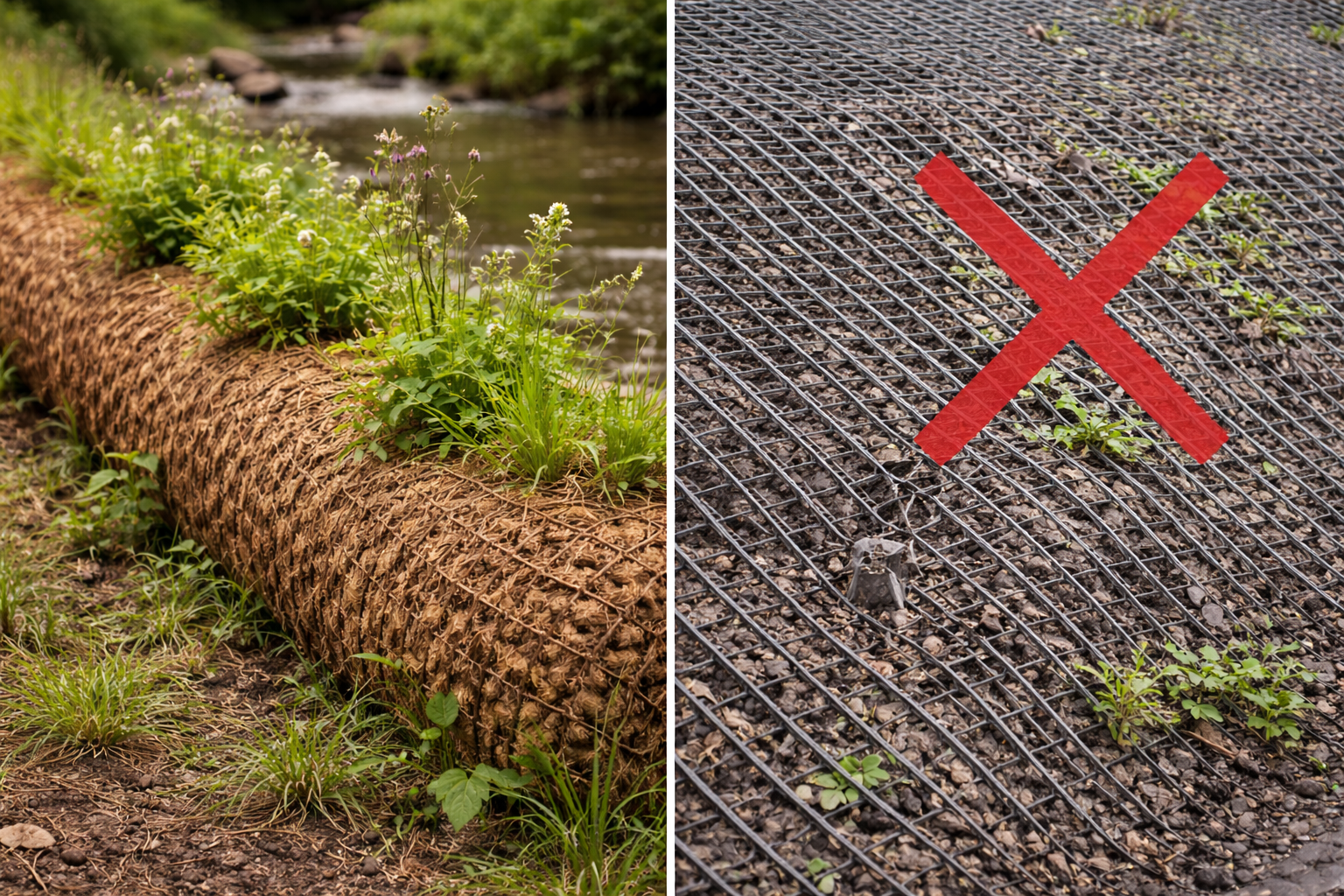
This approach has shaped the widespread adoption of synthetic geotextiles and permanent erosion control systems, where longevity is equated with performance. However, as infrastructure delivery becomes increasingly influenced by carbon accountability, environmental regulation and whole-life asset thinking, this assumption is being challenged.
In many applications, particularly erosion control, the question is no longer how long a material can last, but rather how long it needs to perform.
Biodegradability as engineered performance
Biodegradability is often misunderstood within engineering contexts, perceived as a limitation, or a compromise against strength and reliability. In reality, when correctly specified, it represents a highly controlled and purposeful design characteristic.
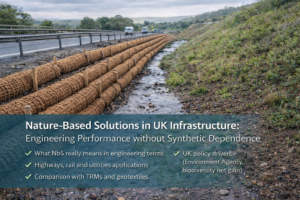
Natural fibre systems, including coir and jute-based geotextiles, are engineered to deliver:
- immediate surface stabilisation
- sediment control
- moisture retention
- a favourable environment for vegetation establishment
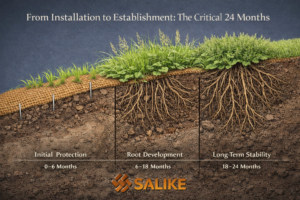
Crucially, these systems are designed to degrade over time, not unpredictably, but in alignment with the development of root structures and natural stabilisation processes.
This is not material failure. It is engineered succession.
Temporary function, permanent outcome
The effectiveness of many erosion control interventions is inherently time-bound. Once vegetation is established, the long-term stability of a slope or channel is governed by biological systems rather than installed materials.
In this context, permanent synthetic solutions may introduce unnecessary persistence, remaining within the environment long after their function has been fulfilled. This can lead to:
- residual material within soil systems
- long-term environmental impact
- unnecessary lifecycle carbon burden
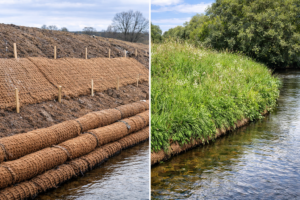
By contrast, natural fibre systems operate as transitional infrastructure – performing a critical role during early-stage stabilisation before yielding to the landscape they support.
The result is not a temporary solution, but a permanent, naturally stabilised outcome.
Aligning engineering with policy and practice
This shift in design thinking is increasingly aligned with the UK’s regulatory direction. Under the Climate Change Act 2008 and the Environment Act 2021, infrastructure projects are expected to minimise environmental impact, reduce carbon emissions and support biodiversity outcomes.
Material selection is therefore no longer a purely technical decision. It is a strategic one, influencing not only performance, but compliance, reporting and long-term asset responsibility.
Designing for degradation allows engineers to meet these requirements in a proportionate and intelligent manner.
A new engineering logic
The distinction between temporary and permanent solutions is becoming increasingly blurred. More accurately, it is being replaced by a new framework:
Materials should endure only for as long as they are required to perform.
This represents a fundamental evolution in engineering logic, from designing for resistance to designing for transition.
At Salike®, we view natural fibre systems not as alternatives to conventional materials, but as a more precise response to the realities of erosion control. By aligning material performance with ecological processes, it is possible to deliver solutions that are not only effective, but inherently complete.
In this context, degradation is not a weakness to be mitigated, it is a performance outcome to be designed.